Blog

Your Only Comfort

I hope this New Year finds you well!

At Grace Kernersville, we continue to celebrate the season of Christmastide, but we will also be entering into the season of Epiphany (which is January 6). GPC’s Sunday school hour on January 5th will be given to acknowledging Epiphany and learning more about the holiday and season. In addition, this Sunday’s Sunday school is a family-wide event, and we will have activities for young and old.

A way to think about these two seasons and their relationship with one another is to imagine the difference between Christmas as a day and the practice of giving and opening presents on Christmas. Epiphany is the day in which the church remembers opening the gift of Christmas. The magi give gifts upon visiting the Christ-child, and the church gets to open the present of the coming of Jesus Christ. “Epiphany” itself means “manifestation”. In other words, Epiphany is like a revelation. As the church celebrates Epiphany, we recall those events when Jesus first manifest himself as the Christ — whether with the wise-men who sought the “King of the Jews” or in his baptism when the Voice spoke from heaven or when he performed his first miracle in Cana of Galilee.

This Sunday is also the first Sunday or Lord’s Day of 2020 and that means that we start over in our annual running through the Heidelberg Catechism during the worship service. You may learn more about the Heidelberg Catechism HERE.

The Heidelberg Catechism is divided into three parts: our estate of sin and misery, the means by whom we are delivered from sin and misery, and how we may live in gratitude for this deliverance. In addition, the Heidelberg explains the content of our Christian faith by helping us understand what the Apostle’s Creed teaches, how we obey God by living obediently according to the moral law, and what we mean when we pray the Lord’s Prayer.

Here are a couple of reasons why I like the Heidelberg Catechism.

  • It is simple: misery, deliverance from misery, and living gratefully for the deliverance from sin and misery. The Heidelberg addresses complex theological questions and answers them plainly.
  • It follows the rhythm of the year as we experience it. When we are heading into Holy Week, we are talking about Jesus and his work as professed in the Apostle’s Creed. As we move into Ordinary Time, we are talking about the life of faith lived out in obedience. As we move into Advent we talk of prayer which is the language of hope.
  • Lastly, it is pastoral and applicable. As the Heidelberg is simple, it is also plain in its speaking. The Heidelberg Catechism is direct and speaks to reality as it is lived.

This Sunday’s first question and answer is one of the most appreciated in the entire Catechism as well as among all Protestant catechisms. It asks and answers:

Q. What is your only comfort in life and in death?
A. That I am not my own, but belong—body and soul, in life and in death—to my faithful Savior Jesus Christ. He has fully paid for all my sins with his precious blood, and has set me free from the tyranny of the devil. He also watches over me in such a way that not a hair can fall from my head without the will of my Father in heaven: in fact, all things must work together for my salvation. Because I belong to him, Christ, by his Holy Spirit, assures me of eternal life and makes me wholeheartedly willing and ready from now on to live for him.

That’s not a bad way to start the new year. You may access the version of the Heidelberg Catechism which Grace Kernersville uses HERE.

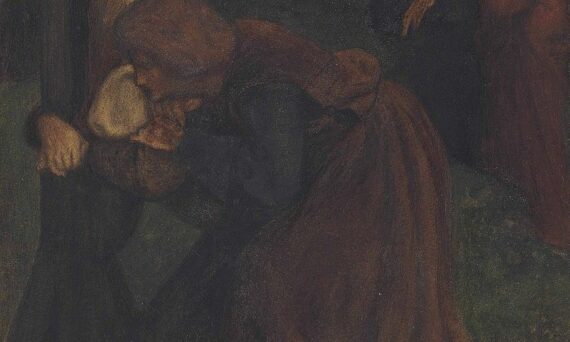
And finally, the artwork which accompanies the post is by Dante Gabriel Rossetti (1828–1882), the brother of poet, Christina Rossetti. The painting is titled, St. John Comforting the Virgin at the Foot of the Cross. In Rossetti’s depiction of the event, I imagine that Jesus has just spoken his last words to Mary, “Woman, behold your son.” This beholding is not merely directing Mary to the Apostle John who would take her into his home, but it mirrors his words to her at the beginning of John’s gospel. In John 2 Jesus is asked to come to the aid of those throwing the wedding feast because the wine has run out. Jesus speaks to her saying, “Woman, was has this to do with me? My time has not yet come.” Several years ago I attempted to capture this interaction and its connection with John 19:25-26 via a sonnet.

Finding us outside as we waited on
Our master who brought us to the wedding,
His mother, not asking, telling her son
The shameful news the bridegroom was dreading.
“The wine has runout,” in question she eyed
Looking for what he might say and do.
“Woman, what’s that to me? My time’s not arrived.”
To the servants, “Do whatever he tells you.”

It’s been three years since he turned water to wine;
We stand at the foot of his crushing shame
Twisted round a stake like vintner’s vine
Is her son who saved a bridegroom’s good name.
“Why?” pours from her eyes in sobs overcome,
The wine saved for last, “Woman, behold your son.”
© Randall Edwards 2017

We will be looking at John 2:1-11 as a part of our recognition of Epiphany. I hope to see you Sunday. Until then, Merry Christmas and Happy New Year!

 

Scripture Reading in 2020

Have you considered attempting to read through the Bible in a year? In years past Grace Kernersville has used Scottish pastor and missionary, Robert Murray McCheyne’s reading plan. You can read more about it’s beginning HERE.

Also, the ESV Bible app is another good place to find a reading plan which you may access via their smartphone/tablet app or via their website HERE.

Or maybe you’d like to sit and listen to someone read the Scriptures and possibly gather others to listen with you. A program and app entitled, The Public Reading of Scripture is available HERE.

These are just a few ideas. If you have others, let us know! Happy New Year!

We Beheld His Glory

Before I get to this weekend’s service, I’d like to remind all that GPC’s Sunday school hour is off until January 5, 2020 when we will have a Family Sunday school hour on the topic of Epiphany. January 5 is the 12th day of Christmas, and January 6 is Epiphany. I hope to see you at 10:30am for worship and the Lord’s Supper on December 29th.

On the subject of the 12 Days of Christmas, you may enjoy listing to how the twelve days of Christmas were celebrated in this region in previous years by listing to Paul Brown’s episode on Across the Blue Ridge, entitled, “Breaking Up Christmas.”

This Sunday, we begin a three week series for the seasons of Christmas and Epiphany entitled, We Beheld His Glory. On Sunday the 29th, we will be looking at Matthew 2:13-23. Traditionally on December 28 the church remembers Herod’s killing of the children in the region of Bethlehem which leads to the flight of Mary and Joseph to Egypt. We will be looking more closely at Joseph and how his life mirrors another Joseph whose actions led to deliverance.

My favorite depiction of the flight to Egypt is painted by Henry Osawa Tanner. You may enjoy reading this article about Tanner and his painting HERE.

It’s still Christmas!

Bread of Heaven

At Grace Presbyterian’s Christmas Eve service, we heard of the the implicit connection which is drawn from the meaning of the name of Bethlehem (house of bread) and that Jesus is laid in a manger. In Jesus’ birth, Luke is showing us that the Desire of Nations spoken of in Haggai has in fact, come. In John’s gospel, Jesus makes the connection more explicit when he says in John 6:35-40,

“I am the bread of life; whoever comes to me shall not hunger, and whoever believes in me shall never thirst. But I said to you that you have seen me and yet do not believe. All that the Father gives me will come to me, and whoever comes to me I will never cast out. For I have come down from heaven, not to do my own will but the will of him who sent me. And this is the will of him who sent me, that I should lose nothing of all that he has given me, but raise it up on the last day. For this is the will of my Father, that everyone who looks on the Son and believes in him should have eternal life, and I will raise him up on the last day.”

I read this spoken word piece in which I re-imagined Jesus’ words and my own response in which you may listen to me read here. The text is below. Merry Christmas!

[soundcloud url=”https://api.soundcloud.com/tracks/216359159″ params=”color=#ff5500&auto_play=false&hide_related=false&show_comments=true&show_user=true&show_reposts=false&show_teaser=true” width=”100%” height=”166″ iframe=”true” /]

They asked him about the Bread of Heaven.
And so he told them:
“There’s no work that can earn it.
There’s no sin that can’t be overcome by it.
If you are in it you can’t resist it.
If you want it you won’t be denied it.
Moses didn’t give it.
He merely told them about it.
For it was the Father who gave them manna
And in a place they couldn’t make it.

And now, even as you hunger,
I am telling you that you are looking at it.
I am the bread come down from heaven.
The bread which nourishes,
Satisfies, sustains — upon which you can rely,
To which he testifies.
Don’t go spending your work and your toil on food that will spoil.

I am the bread.
The bread of all fulfilling,
The Cosmic Gospel-filling,
The fast-ending feast.
A table set for the least.
I have come to end the slow, hard, soul-famine
And give thrilling, life, joy, and peace.
And all fear ended.
I tell you, I am the bread of heaven.”
Now, are you hungry yet?
Do you want that filling?
Tired yet of that life you are killing yourself for
And your spouse and mother and father and friend?

He’s the bread come down from heaven.
The bread of God unleavened.
Pierced and scored in the furnace of affliction,
Bearing for us, God’s malediction.
Cursed for our benediction.

Given for you and your Cosmic Hunger-Thirsting.
Given for you–to you.
It’s him, I’m telling you.
He feeds, nourishes, satisfies, justifies, makes holy and does it solely.
The door is wide open. If to him you’ve been given,
Give in. He’s gonna win
‘Cause the Father has called you–the Spirit will draw you.
Believe in him.
Receive him. Look to him.

Are you hungry yet?
Afraid you’ve been left out of the feast?
Afraid you’re the least?
He said, “Whoever.”
That’s not you?
Never!
He said, “Whoever comes
I will never drum out of line — drive away.
Come while there’s time.”

“I am the bread of heaven,” he said.
“And it’s the will of him who sent me
That I should lose none of those he’s given me.
But I shall win for them a standing in eternity
One long, glorious Olympic victory.
Forever singing the anthem,
‘Worthy, worthy, is the Lamb that was slain!'”
Praise Jesus name.
His love-banner flying overhead in his house of wine.
The love we’ll proclaim and enjoy for all time.
Eternal banquet filling and life
And telling: we believed.
But with the angels shaking,
Stumped, a new breaking in a glorious humility
A person quake,
Shaking our heads, saying,
“Who would’ve believed, that he was the bread
Even for me?”
He said, “I am the bread of heaven.”
Do you hunger?
Do you wonder, “Will I ever be satisfied?”
Believe.
Believe in the Son who is himself now alive
Even though crucified.
And even if you die or have died,
On that the last day you’ll be there
Alive.
Justified.
Sanctified.
Glorified.
Alive.
And full for time upon time
With the Bread of Heaven.

© Randall Edwards 2010.
This is for Christ’s church. If it is helpful, please feel free to copy or reprint in church bulletins, read aloud, or repost. I only ask that an attribution be cited to myself (Randall Edwards) and this blog (backwardmutters.com). Thanks

Christmas Services and Holiday Schedule

There are several changes to our normal routine this week at Grace Kernersville.

Firstly, please come and join Grace in a Candlelight Service on Christmas Eve at 7:00pm. The service is a service of nine lessons and carols and a brief message and is a great way to mark the day and celebrate together as we remember that darkness has not overcome the light and that the light of Jesus Christ still shines.

The church office will be closed December 24-26 and January 1. Please plan accordingly.

We expect the re-shingling of the roof to be compete on December 24, but please be aware that there may be equipment on site and use caution as needed.

There will be no Adult Sunday school on December 29. We resume our regular Sunday school schedule on January 5, 2020 which will also serve as a family Sunday school morning to gather to learn about Epiphany.

Have a blessed Christmas and Happy New Year!
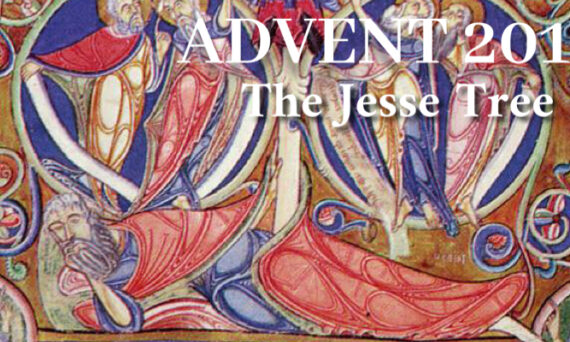
The Jesse Tree: Grapes

The second Sunday of Advent brought our attention to the Promised Land which serves as both a promised home but also a metaphor for the church of the eternal home of God’s people. I write more about this in an earlier post entitled, Could We But Stand Where Moses Stood. Here, GPC artist, Adah Freeman has taken as her inspiration the image of the cluster of grapes brought back from the Valley of Eshcol in Numbers 13. As we move through Advent, we are to consider the longing for the place and reception of home, of abiding, of place, and most importantly, the abiding presence of God.

Take a moment and see what your imagination reads of the painting. How might you bridge from Numbers 13, grapes, the promised land to the coming of the Christ Child? You may read my take in the poem below.

Grapes

Grapes

When we returned from the land of flowing
Milk and honey — full and green and growing,
We carried the abundance, the grapes bursting
With the fruit-full promise: no more thirsting.

But then doubt set in, underneath a mumbling
That bubbled up to a fount of grumbling
The people, giants; their cities tow’ring
And a land full of enemies devouring.

Have we come this far only to die?
To be squashed? Skins left out under the sky?
How will the death of a generation
Bear the fruit: a promised, holy nation?
What pressing and crushing will remove our sin?
What life trod and poured, that we enter in?

© Randall Edwards 2019.
This sonnet is for Christ’s church. If it is helpful, please feel free to copy or reprint in church bulletins, read aloud, or repost. I only ask that an attribution be cited to myself (Randall Edwards) and this blog (backwardmutters.com). Thank you.
artwork: © Adah Freeman 2019, “Grapes” acrylic on canvas.

Jesse Tree Art: Slingshot

GPC’s Advent art project, The Jesse Tree, is being installed. New pieces are on display each Sunday. One of those pieces is a plywood sculpture of the Jesse Tree which I’ll be writing more about later. The other pieces are a combination of abstract art and poetry.

Why Abstract Art?
Representational art is often viewed as being inherently more worthy than abstract art. The seemingly inherit chaos of the art is viewed in some circles as refuting the idea of transcendent truth. This is false. All art abstracts at some level. The artists eye and imagination always works to communicate and focus. Every artist embellishes, adds qualities, or makes use of symbolism. Abstract art, however, does this with an abandon. The artist hands-over the painting’s meaning to the viewer, and in so doing, the viewer’s imagination becomes as important as the artist’s imagination in order to give the painting meaning.

How Do You Read Abstract Art?
There are several cues one may use to help read abstract art. Many abstract paintings have titles. The titles give you some clue as to the artist’s intent. Next, look at the colors and lines. How has the artist used line, color, and flow to communicate? Secondly, look at the larger context used. Is there a theme to the series? What sorts of references may the artist have been drawing from or which you are aware that may help you discern a meaning? Lastly, talk and share with others your ideas. Abstract art is about engaging the imagination and discovering meaning.

Each piece of art in this portion of the Jesse Tree project is accompanied by an ekphrastic poem. Ekphrastic poems are poems which are written in response to a specific piece of artwork. In ekphrastic poetry we are offered a view into the poet’s imagination as they dialogue with the artist’s work.

Here’s the first piece in the series. It corresponds to 1 Samuel 17 and the story of David and Goliath. The painting is titled, “Slingshot.” How do you read the colors? The lines? How can you derive a story from the painting about David’s struggle with Goliath? Because this is part of the Jesse Tree project, how does this relate to Jesus? How might who Jesus is and what he has done be brought to bear in the artwork’s meaning?

IMG_3913 2

© Adah Freeman 2019, “Slingshot” acrylic on canvas. All Rights Reserved.

Here’s my attempt to read the painting in poetry. This poem too, is entitled, “Slingshot.”

Once the world was shining-new, golden-bright,
Untouched by shade or stain but brilliant-white;
Then an enemy came
To steal by dark deeds, claim.

The menacing darkness blurred, broke, and scarred—
Tore with violence, crossed, mangled, marred
The field of shimm’ring gold
Whence all was lost or sold.

The darkness continued to blur and streak,
Sent giants: Despair, Dementor, Defeat
Who laughed at our fear, scoffed,
Defied our Lord, and mocked.

But God’s Shepherd descended in between,
Went outside the camp where he was last seen—
For our glory-sealing,
Bearing stripes for healing.

He flung himself at death, and slew the Night
And with his arms he slings us up in life.

© Randall Edwards 2019.
This sonnet is for Christ’s church. If it is helpful, please feel free to copy or reprint in church bulletins, read aloud, or repost. I only ask that an attribution be cited to myself (Randall Edwards) and this blog (backwardmutters.com). Thank you.

GriefShare Meeting

From the GriefShare website: “GriefShare is a friendly, caring group of people who will walk alongside you through one of life’s most difficult experiences. You don’t have to go through the grieving process alone.”

GRIEFSHARE is a 13 week group seminar focused on helping people learn how to understand their grief from the loss of a loved one or friend. A group will be begin meeting on Monday, January 13, 2020 at the church building. Weekly sessions will continue on Monday evenings from 6:30-8:30 PM. The last meeting will be Monday, April 6, 2020. If you think you may be interested in participating in this opportunity, or have questions about GriefShare, please contact Carolyn or Dick Clatfelter.

See more HERE.

The Suffering Servant

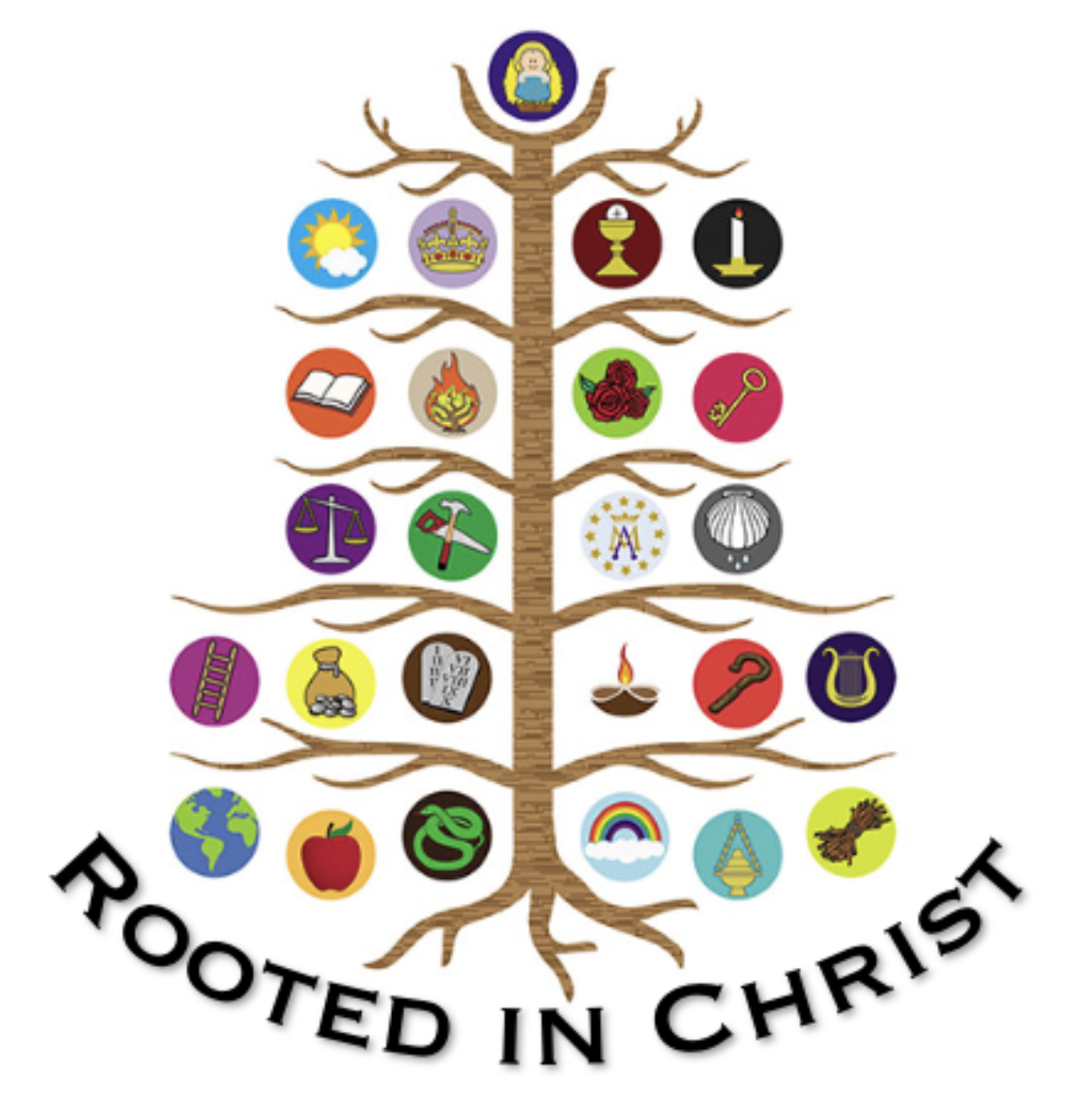
GPC’s Advent theme this year is The Jesse Tree. Over the course of the past year, the older primary aged children have been participating in a class called, Rooted in Christ. In this class students have been learning how Jesus’ coming was foreshadowed in the Old Testament, and they have been making ornaments for a Jesse Tree which you may read more about HERE.

.Screen Shot 2019-12-02 at 7.59.59 AM

This week’s sermon passage is from Isaiah 53, and it foretells of the coming of the Lord’s Suffering Servant. The Advent theme for the second Sunday is “love.” The candle we light in the Advent wreath acknowledges the love of God which is demonstrated in the coming of Jesus Christ, the Suffering Servant.

Now, love is more than a feeling of affection. Though love often begins and continues with desire and affection, love is most often demonstrated rather than felt. We experience love in the lengths to which we go in order to love (oftentimes in the form of our own sacrifice) and in the lengths others go in order to keep loving us. You may read more about that kind of love HERE.

The amazing grace of the gospel is that God has gone to every length in order to save us. Being rooted and established in that love? Well, it’s apparently a power which can be ours if only as Isaiah says in Isaiah 53, we may see the significance of the ‘arm of the Lord’ and believe the message of His revelation.

What is Advent?

The word “advent” comes from the Latin word, adventus for “coming” and thus describes the first season in the church calendar year. It is observed as a season of preparation for what is the “Christ-Mass” — the service in which the coming of Emmanuel, God-with-us, is celebrated.

In today’s celebration Advent and Christmas are conflated into one season. Sadly, we miss an opportunity to prepare. Tish Harrison Warren, writes this weekend of the significance of Advent. The title in her article in the New York Times gets to the heart of it. “If you want to get into the spirit of Christmas, face the darkness.” You may read it here.

Many churches (and Grace is one), mark the season by lighting Advent wreath candles. The use of candles during the Advent season originated in Germany prior to the Reformation. Originally, there were only four Advent candles: three purple candles and one pink candle. The purple candles matched the purple paraments (the cloth that lays on the altar and the pulpit) and signified the coming King Jesus. (Purple is the color of royalty). The Pink candle is the third candle to be lit, and it is lit on Gaudate Sunday, (the third Sunday in Advent). “Gaudate” means “Rejoice!” in Latin, and is the first word for the traditional introit for that day which is taken from Philippians 4:4-5 “Rejoice in the Lord always. I will say it again: Rejoice! Let your gentleness be evident to all. The Lord is near.” The white candle or the Christ Candle was added later and obviously represents Christ and was to be lit during the twelve days of Christmas (Dec 25-Jan 5).

GPC follows a common practice of identifying each of the candles with a theme. The themes each week are: hope, love, joy, and peace. The sermon passages will pick up on those themes.

As you prepare for the celebration of the coming of Jesus Christ, you may want to look at these resources.
How December 25 Became Christmas.
Malcom Guite speaking on Advent.
Biola University’s Advent Devotional.